How the PROSPECTS Partnership Transforms Systems and Lives
A new way forward for displaced and host communities
Dec 12, 2025
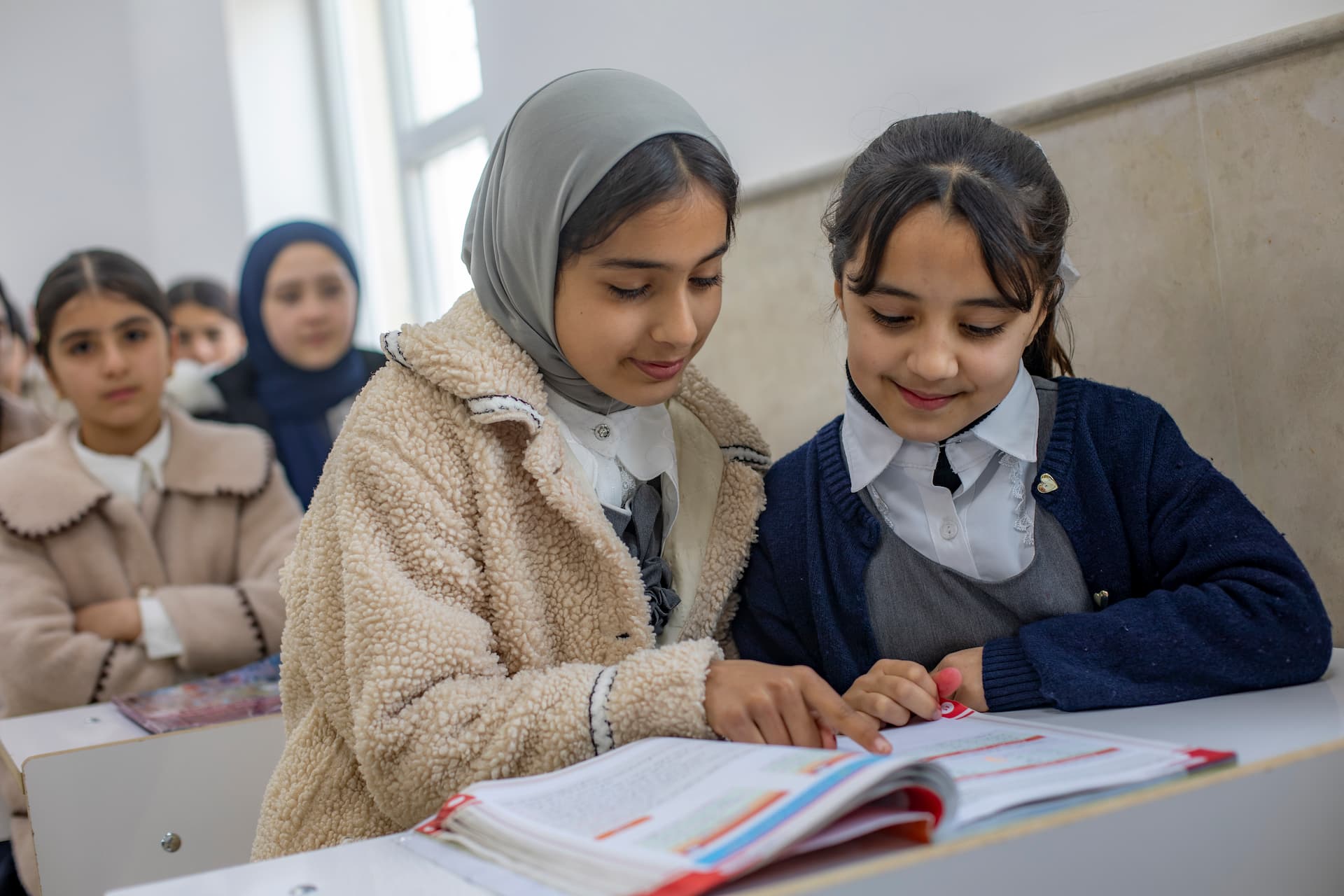
Over 500 students and teachers from refugee and host communities benefit from Mala Birwan School, a newly constructed school that is part of Refugee Education Integration Policy efforts in the Kurdistan Region of Iraq. © UNHCR/Rasheed Rasheed
Traditional systems are struggling to keep pace with the challenges of forced displacement. The number of people forced to flee their homes has doubled from what it was just a decade ago – today, it stands at more than 123 million people. This includes 42.7 million refugees and over 73.5 million internally displaced persons (IDPs).
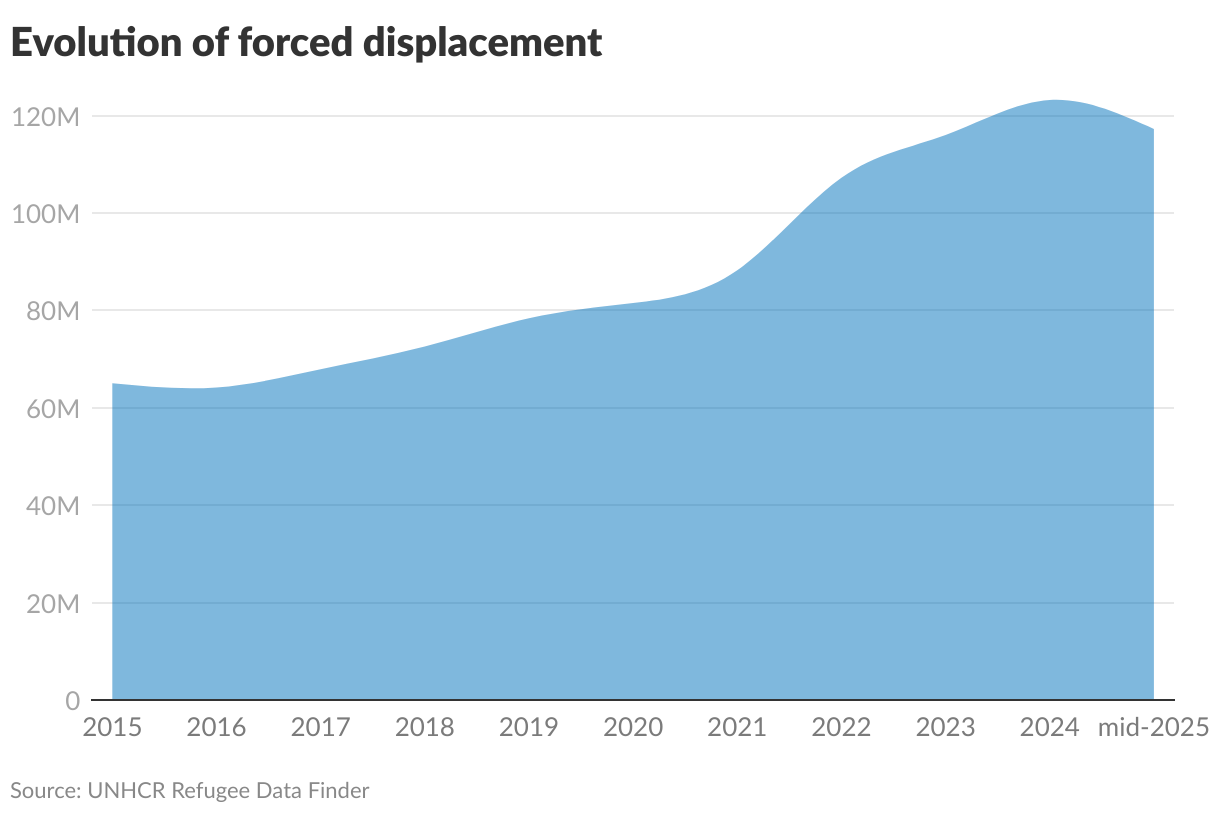
Today, at least one in every 67 people worldwide is forcibly displaced – nearly double what it was a decade ago. Nearly 73 percent of them live in low- and middle-income countries.
Behind those unprecedented numbers are children seeking an education, youth and adults searching for work, and vulnerable host communities generously sharing limited resources. It’s a historic crisis that demands real systemic change.
The PROSPECTS Partnership – supported by the Government of the Netherlands – is committed to helping catalyze that change.
Where PROSPECTS works
The Partnership is currently implemented in eight refugee-hosting countries: Egypt, Ethiopia, Iraq, Jordan, Kenya, Lebanon, Sudan, and Uganda. These nations are affected by some of the world’s largest and most protracted displacement situations, including conflict and crisis in neighboring countries like Somalia, South Sudan and Syria.
Together, they host more than 25.5 million forcibly displaced people – over 20 percent of the global total. This figure includes Sudan, where there are approximately 11.6 million internally displaced persons (IDPs), the largest such crisis in the world.
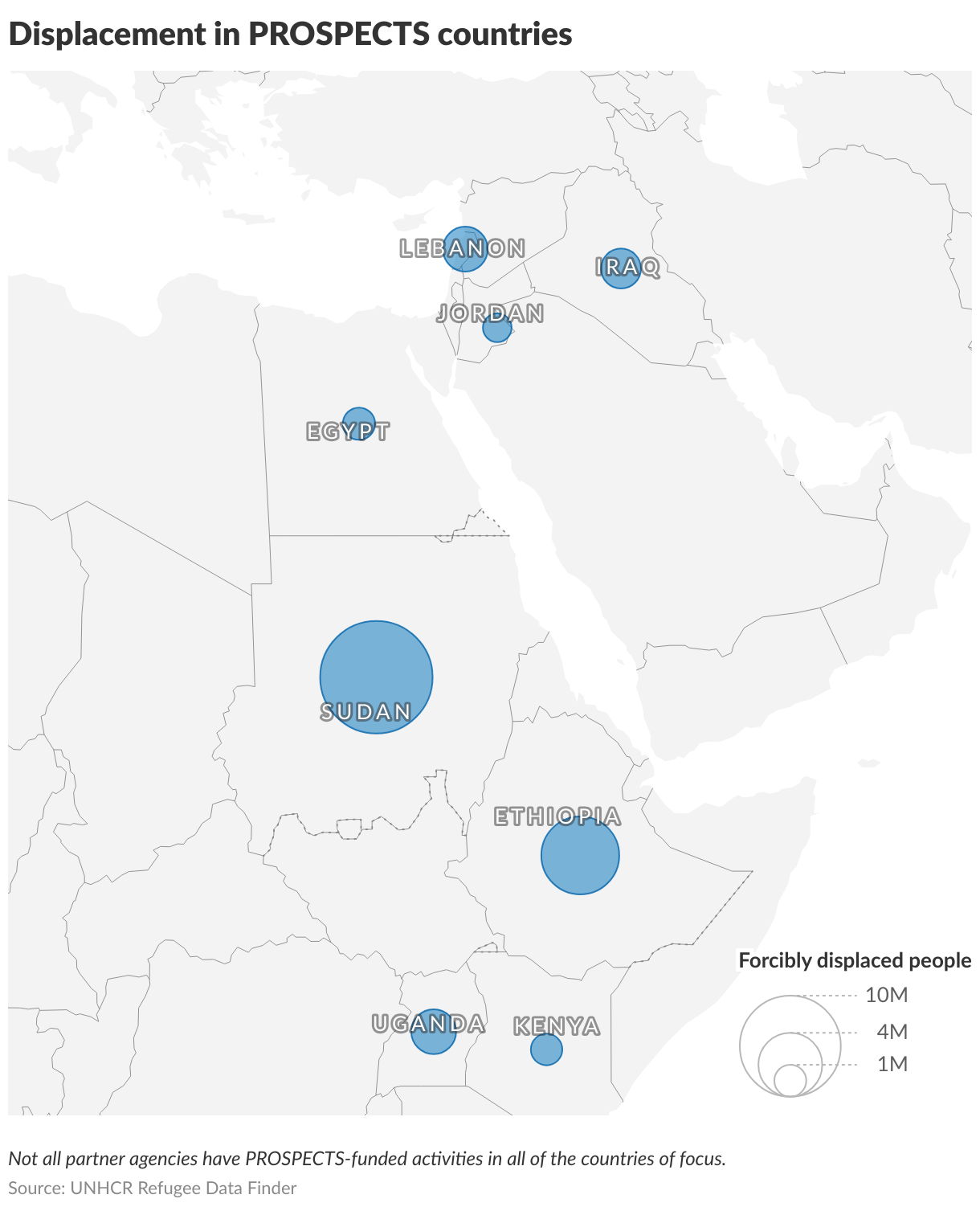
Displaced populations in these countries still struggle to gain equitable access to livelihood opportunities, education and social protection. At the same time, these are places where policy change is possible, and where a multi-agency partnership can meaningfully accelerate national reforms to ensure inclusion for all.
A partnership for lasting inclusion
PROSPECTS is designed to transform the way that governments, civil society, the private sector, and other stakeholders collaborate to help forcibly displaced people and the communities that host them. Launched in 2019 at the first Global Refugee Forum, it bridges development and humanitarian programmes by combining the strengths of five global partner agencies. Each partner contributes its unique expertise and mandate for sustainable change.


Data guides every stage of PROSPECTS – informing us where to act, how to adapt and how to measure progress. Together, the Partnership is committed to bridging humanitarian and development efforts to unlock system-level change in some of the world’s most challenging contexts.
PROSPECTS: Transforming the Response to Forced Displacement
PROSPECTS advances resilience, inclusion and self-reliance, empowering forcibly displaced and host communities today, and strengthening societies for tomorrow.
How PROSPECTS Works: The Four Pillars
Inclusion sits at the heart of PROSPECTS, because real, sustainable change can happen when everyone has a fair chance to learn, work and be protected. It bolsters public services and allows people to rebuild their lives with dignity and purpose. When more people are allowed the chance to contribute in meaningful and consistent ways, communities become more resilient.
That is what PROSPECTS is working towards through four interconnected pillars, designed to reinforce each other and strengthen opportunities for forcibly displaced people, host communities and the national systems that support them.
Education and Learning
Ensure access to quality education through integration into national systems, technical and vocational training, and other engagement activities that strengthen future opportunities.
Economic Inclusion
Focus on expanding access to dignified work, skills development and private-sector growth, creating the foundation for long-term economic inclusion.
Protection and Social Protection
Reinforce the legal, policy and community-based frameworks that safeguard rights and child protection, expand documentation and civil registration, and strengthen national safety nets that benefit both refugees and vulnerable host populations.
Critical Infrastructure
Invests in services and systems such as water, sanitation, energy, connectivity, and sustainable urban development, empowering communities to withstand shocks and pursue durable solutions.
Together, these pillars enable PROSPECTS partners, governments, civil society, and other stakeholders – including forcibly displaced people and host communities – to deliver results that are both immediate and long-term. This means more children learning, more people gaining skills, stronger protection frameworks, and infrastructure that improves daily life while accelerating sustainable responses and preparing communities for tomorrow’s challenges.
Protection and Social Protection
Protection and Social Protection is the foundation that allows people to live in safety, exercise their rights, and participate fully in society. Across PROSPECTS countries, this pillar has translated into concrete progress on systems strengthening. Through coordinated, evidence-driven action, the Partnership is helping expand legal protection so refugees and host-community members can secure the documentation and legal status they need to move freely, access services and rebuild their lives.
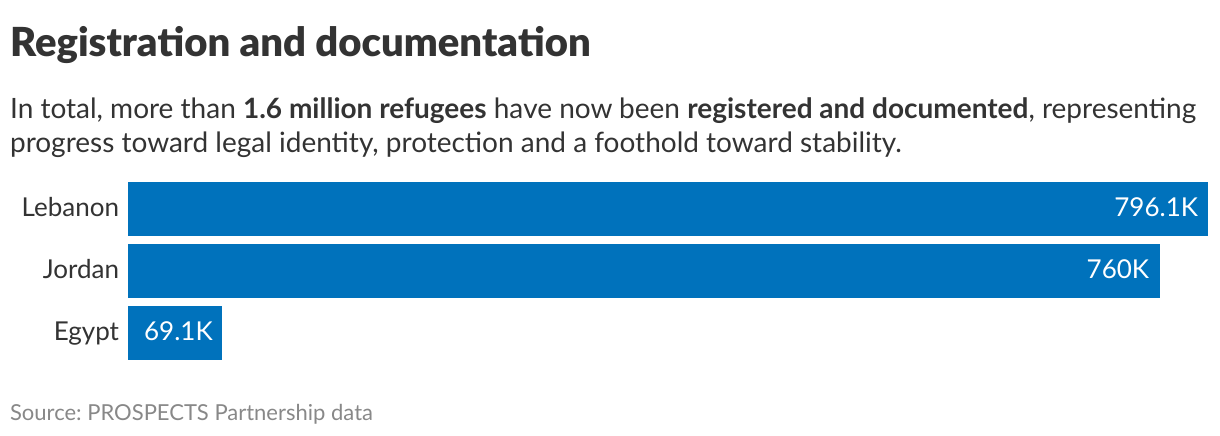
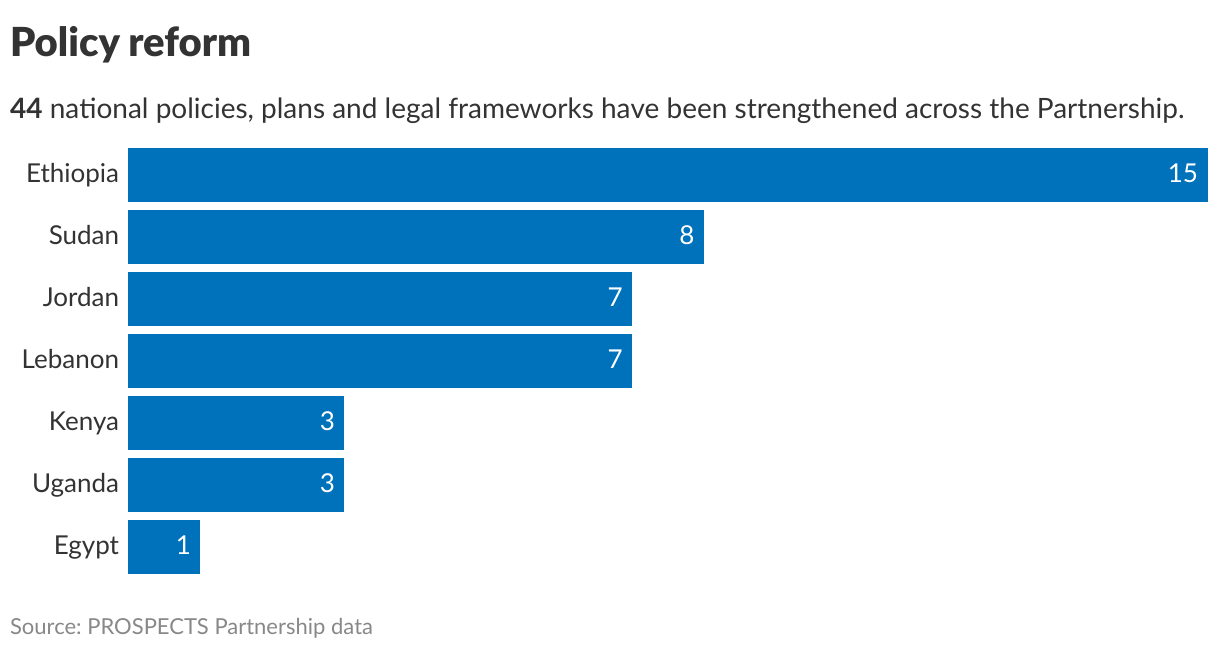
This progress is possible because PROSPECTS works closely with national authorities – supporting policy reform, operational capacity and protection monitoring – to reinforce the systems at the heart of inclusion. Forty-four national policies, plans and legal frameworks have been strengthened across the Partnership, helping expand access to protection and social protection for refugees and host communities. Countries such as Ethiopia (15), Sudan (8), Jordan (7) and Lebanon (7) made especially significant strides, with additional reforms in Kenya, Uganda and Egypt that fortify systems from documentation pathways to national safety nets.
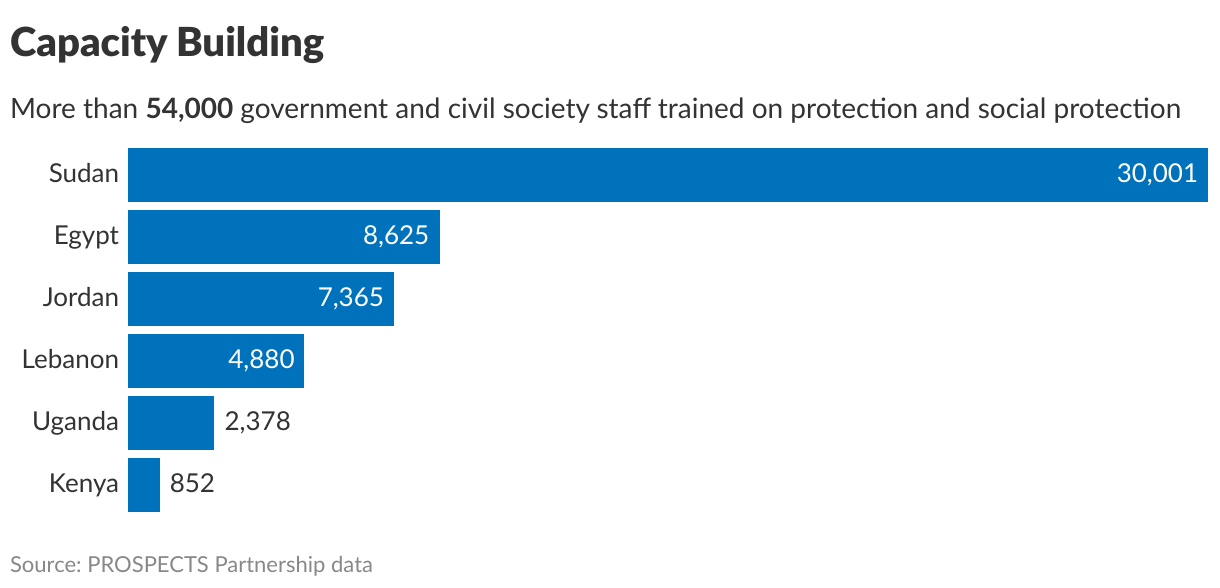
But system change requires people – trained, capable and confident in delivering services grounded in rights and dignity. Across PROSPECTS countries, more than 54,000 government and civil society staff have been trained to improve protection monitoring, gender-based violence (GBV) response, child protection, labour rights, and access to national services. Sudan led with more than 30,000 trained personnel, followed by Egypt (8,625), Jordan (7,365), Lebanon (4,880), Uganda (2,378), and Kenya (852). Every training strengthens frontline capacity, expanding the reach and quality of national systems.
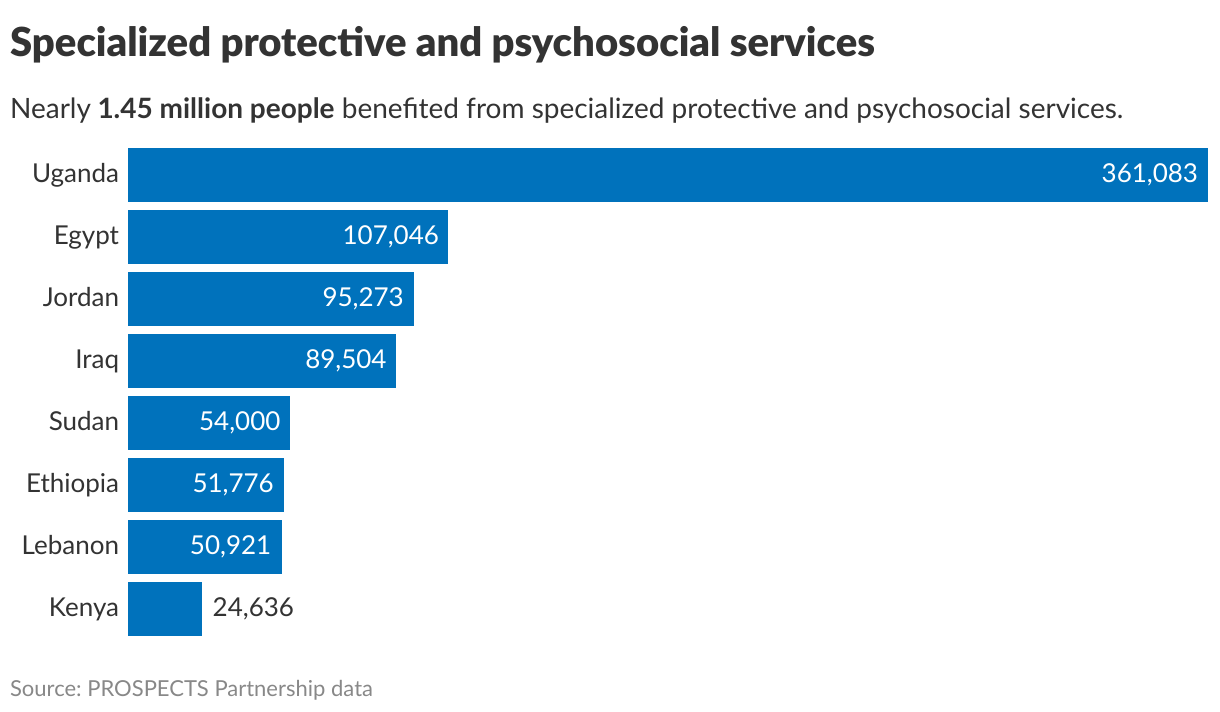
These reforms and investments translate into direct support for people navigating some of the most difficult moments in their lives. Nearly 1.45 million individuals have benefited from specialized protective and psychosocial services – from case management and GBV support to child protection and mental health and psychosocial support (MHPSS). Uganda alone supported 361,083 people, followed by Egypt (107,046), Iraq (89,504), Jordan (95,273), Sudan (54,000), and Lebanon (50,921). These interventions help individuals heal from trauma, recover a sense of safety, and re-engage in school, work and community life.
At its core, PROSPECTS’ protection and social protection work is about strengthening national systems so they serve everyone – refugees and host communities alike. By investing in legal protection, documentation, inclusive policies, and the capacity of national institutions, the Partnership is laying a durable foundation for dignity, safety and long-term inclusion.

Inclusion in Ethiopia's national digital ID program
With support from PROSPECTS, refugees in Ethiopia are being integrated into the country’s digital ID system opening access to critical services and new opportunities.
Education and Learning
Conflict and crisis interrupt learning in ways that can shape a lifetime. Across the Middle East and North Africa, an estimated 30 million children are out of school, and PROSPECTS countries are deeply affected by this reality. In Jordan, for example, only about 60% of refugee children are enrolled in primary school, and that number falls to just 34% in secondary – a stark reminder of how quickly opportunity can narrow for displaced children and youth. Refugees face numerous challenges in accessing quality training and decent jobs include the under-utilization of skills, a lack of employment or training opportunities, lack of information on available learning opportunities, and exploitation of low-skilled workers.
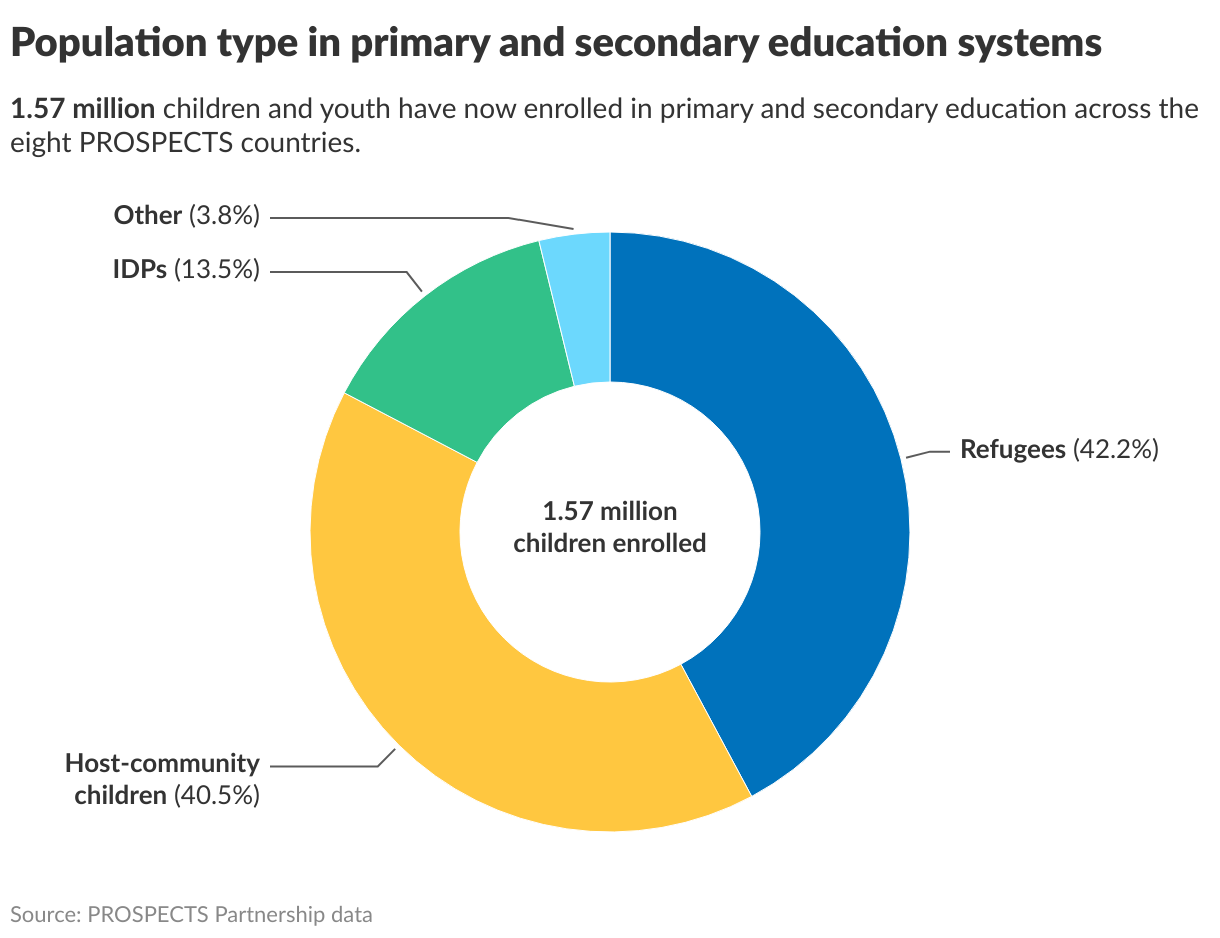
Education and Learning is central to PROSPECTS’ vision: ensuring that every displaced child and young person has the chance to learn, grow and shape their own future. Instead of building parallel systems, PROSPECTS works within and alongside national structures to strengthen and expand public education systems so they can include those historically left behind. This approach is already shifting access at scale. More than 1.57 million children and youth have now enrolled in primary and secondary education across the eight countries, with especially significant gains in Egypt (524,262 learners), Iraq (503,520), Kenya (205,120) and Uganda (203,328). Refugees make up roughly 42% of these learners, while host-community children account for 40%, demonstrating how investments in national systems benefit everyone.
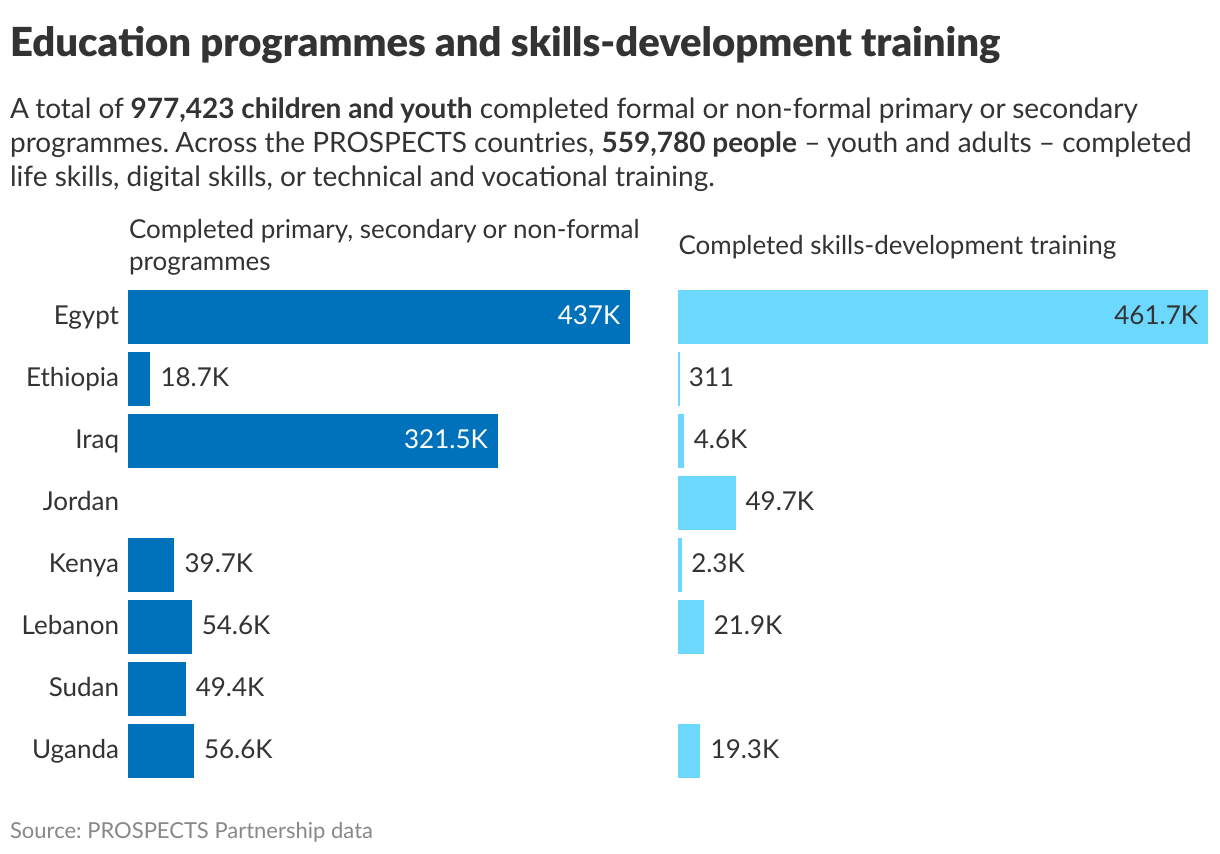
Enrollment, however, is only one step toward meaningful inclusion. PROSPECTS places equal emphasis on helping children and youth complete their learning pathways – formal or non-formal. So far, nearly one million learners (977,423) have completed primary, secondary or non-formal programmes, including notable progress in Egypt (436,954) and Iraq (321,528). Nearly half of all those who completed were host-community members, underscoring the systemic impact of strengthening national education systems.
Learning is also about preparing young people and adults for a future of dignified work. Based on labour market needs PROSPECTS connects young people to technical and vocational training, digital and life-skills programmes, apprenticeships and work-based learning. These investments have already achieved notable results: more than half a million people (559,780) have completed skills-development training. Egypt alone accounted for 461,695 completions, with further momentum in Jordan (49,677) and Lebanon (21,933). Nearly 65% of participants come from host communities, reflecting PROSPECTS’ commitment to shared benefits, social cohesion and stronger national labour markets.
And because education is not only about systems but also about agency, PROSPECTS creates opportunities for young people to lead – mentoring peers, navigating post-secondary options, participating in decision-making, and shaping the solutions that affect their own lives. Across classrooms, training centres and community spaces, the PROSPECTS is helping to build an environment where displaced and host-community youth can imagine – and pursue – futures that once seemed out of reach.
Refugee youth find new PROSPECTS - Touqa and Taima's story
Taima, a 25-year-old Syrian refugee, and Touqa, a 23-year-old from a marginalized host community in Jordan, share more than just challenges – they share resilience and determination. Through UNICEF’s Learning to Earning programme – supported by PROSPECTS – both young women have gained the skills and confidence to build brighter futures.
Livelihoods and Employment
The Employment and Livelihoods pillar is where PROSPECTS helps turn opportunity into independence. By promoting inclusive economic growth, the Partnership helps refugees, host-community members and others access opportunities through employment services, entrepreneurship development, labour-intensive programmes, and digital jobs.
PROSPECTS works across systems: strengthening institutions, engaging the private sector, expanding access to finance, and tackling the legal and practical barriers that keep displaced people from fully participating in the economy. At its core, this pillar is about opening doors to dignified work and ensuring people have the freedom — and the right — to earn a living.
At the same time, PROSPECTS invests in creating an enabling environment that unlocks those opportunities. Partners support short-term employment-intensive public works, small-business growth, business development, financial inclusion, cooperatives development, and the market linkages that connect people to real jobs and value chains. Through close collaboration with employment service providers, employers and communities, PROSPECTS promotes fair recruitment, decent working conditions, and stronger labour protections for all. It’s a comprehensive approach that strengthens local economies, enhances social cohesion, and ensures refugees and host communities can fully contribute to, and benefit, from economic inclusion.

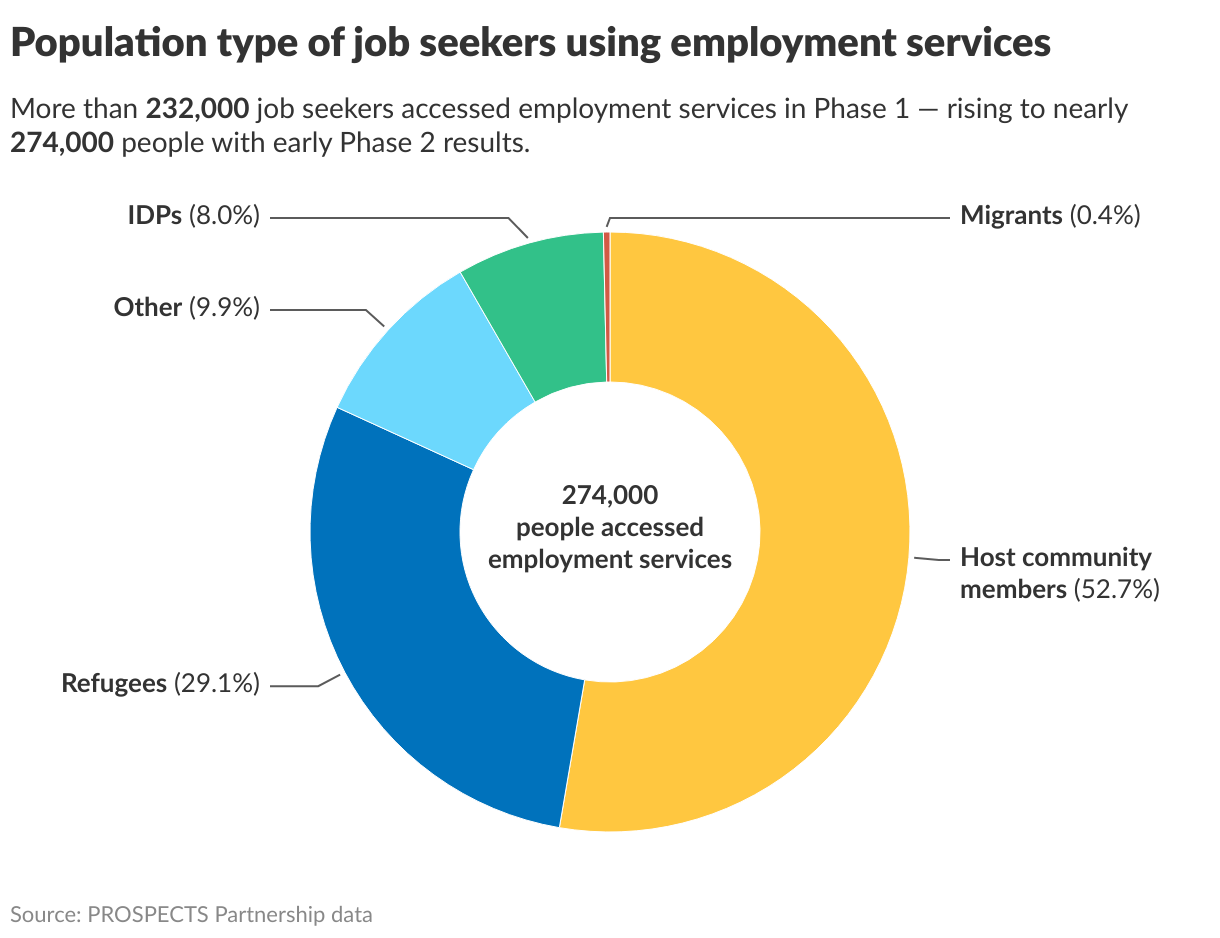
One of the clearest signs of this progress is the growing reach of employment services across PROSPECTS countries. More than 232,000 job seekers accessed employment services in Phase 1 — rising to nearly 274,000 people with early Phase 2 results. Jordan alone connected 210,252 people to employment support, while Iraq (15,068), Uganda (5,935), Lebanon (692), Egypt (516) and Kenya (239) also expanded their reach. Notably, host-community members accounted for more than half (52.7%) of all participants, and refugees for 29%, underscoring broad demand across both groups and the value of integrated, national employment systems.
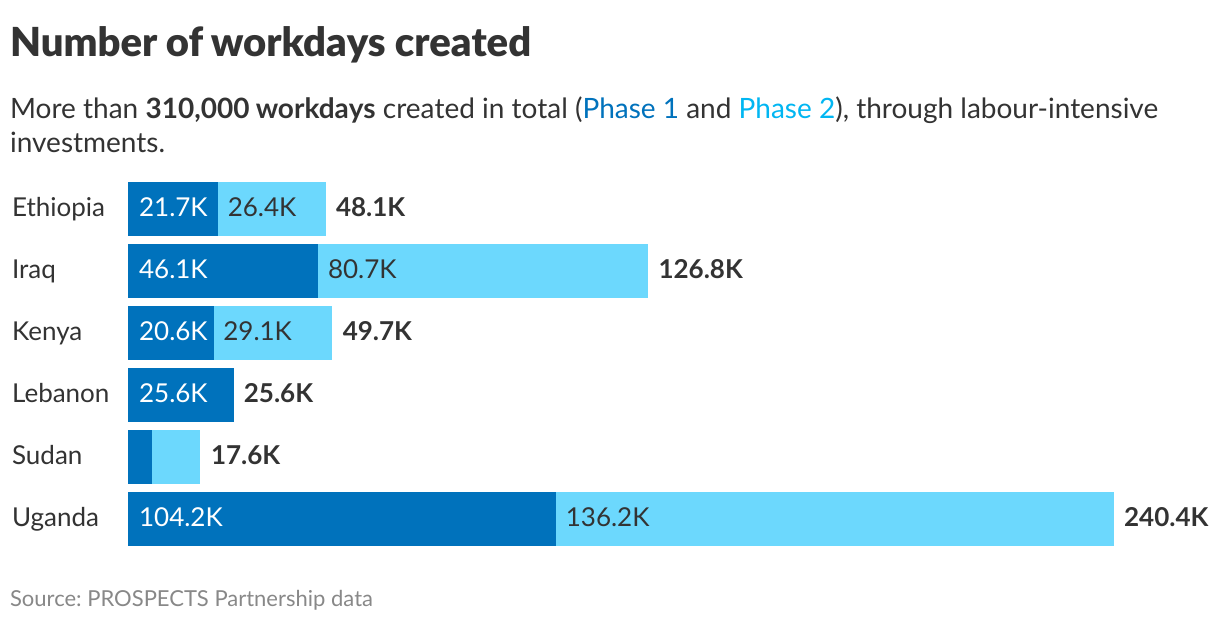
But connecting people to services is only part of the story. To date, PROSPECTS activities have helped to create more than 310,000 workdays, including 197,928 during Phase 1. Uganda contributed the highest number of workdays (136,240), followed by Iraq (80,653), Kenya (29,146), Ethiopia (26,413), and Lebanon (25,571). In Phase 2, over half (53.2%) of all workdays benefited host-community members, with refugees benefiting from 43.6% — reinforcing the commitment to support shared resilience.
PROSPECTS invests in the economic ecosystems that sustain long-term growth. Small-business development, access to finance and market linkages help people build, expand and stabilize their livelihoods. So far, nearly 200,000 people (199,617) have benefited from business development or financial services, including major results in Egypt (146,179), Jordan (24,120), Uganda (10,676), and Lebanon (5,891). This support is enabling refugees and host-community entrepreneurs – along with other vulnerable groups — to access credit, increase income and connect to markets.
PROSPECTS For Marwa’s Business and a Better Future
Marwa was forced to flee conflict in Syria alongside her family. Arriving in Egypt, the PROSPECTS Partnership helped her through training and other support to build a successful sewing business. Today, she employs others in her community and is investing in her future.
By upgrading business development and financial education services, expanding access to finance and improving labour protections, PROSPECTS is not only opening pathways to work but also helping shape more inclusive economies — where refugees and host-community members alike can contribute, prosper and build futures rooted in dignity and opportunity.
Critical Infrastructure
Critical Infrastructure is the newest PROSPECTS pillar, and it strengthens the essential services that help strengthen inclusion, resilience and sustainability. Added in 2024 at the beginning of Phase 2, this pillar focuses on improving water and sanitation systems, solid waste management, housing and shelter, and digital connectivity. In many contexts, displaced people are still served by parallel or camp-based systems. PROSPECTS works to change this by promoting integrated, sustainable infrastructure that serves both refugees and host communities, reducing isolation and expanding equitable access.
These investments do much more than build physical structures; they strengthen national systems and open pathways to opportunity. Labour-based approaches to infrastructure development provide training, employment opportunities, income, and hands-on experience, reinforcing the Livelihoods and Protection pillars while improving community safety and resilience.
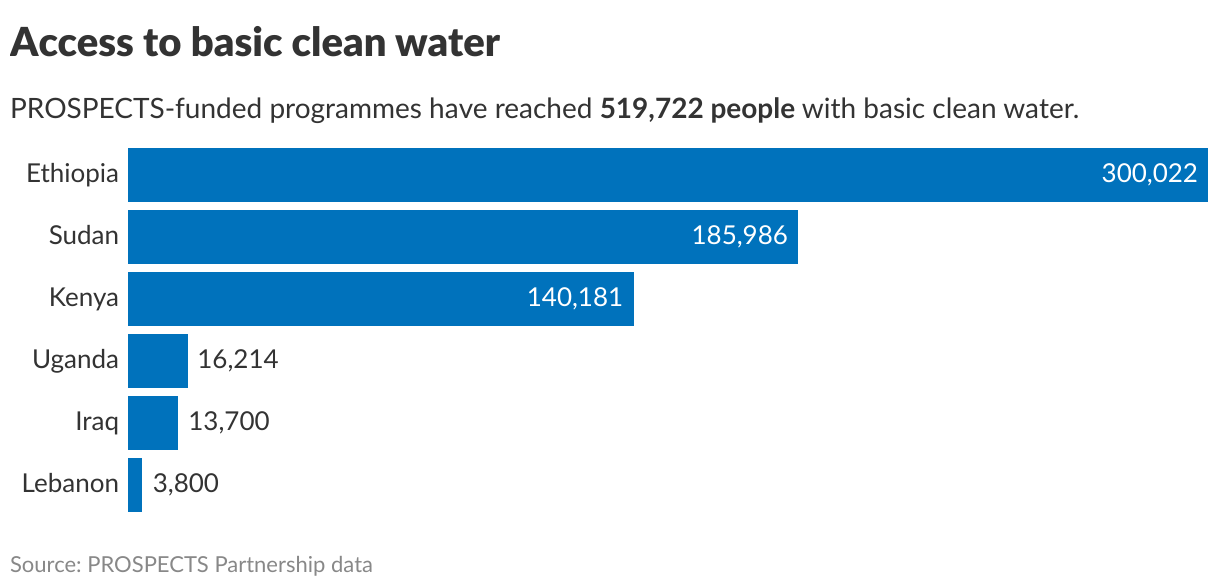
Although the activities for this pillar have only recently started, they have already resulted in significant outcomes in digital connectivity, sanitation and water. As of today, PROSPECTS-funded programmes have reached 519,722 people with basic clean water, including 300,022 in Ethiopia, 140,181 in Kenya, 185,986 in Sudan, 16,214 in Uganda, 13,700 in Iraq, and 3,800 in Lebanon. This means the Partnership is 61% of the way toward its target of 841,681 for this particular indicator.
PROSPECTS supports the institutions that manage public services, ensuring long-term sustainability and inclusion. Together, these efforts create a foundation for rights, services and economic participation, amplifying the impact of the other PROSPECTS pillars.
Measuring what matters: Monitoring, Evaluation and Learning (MEL)
At the heart of PROSPECTS is a shared commitment to learning from evidence. Through annual Monitoring, Evaluation and Learning (MEL) sessions at country, regional and global levels, PROSPECTS partner agencies come together to review progress, analyse data and reflect on results. These sessions use a common results framework to review progress, analyse results and adjust outcomes across all four PROSPECTS pillars. By jointly assessing achievements and challenges, teams identify what works, what needs adjustment and how innovations from one context can be adapted and scaled across others.
MEL helps keep PROSPECTS dynamic and accountable. It transforms data into shared insight, ensures transparency to the Government of the Netherlands and other stakeholders – including the communities it serves – and strengthens national partners’ ability to monitor results long after projects end. Most importantly, MEL helps the Partnership adapt – refining strategies to better support forcibly displaced people and their host communities.
Why PROSPECTS matters, here and now
The number of people forcibly displaced from their homes is growing, while resources available to support them are diminishing. By aligning humanitarian relief with long-term development, PROSPECTS helps create inclusive systems that benefit everyone.
As the Partnership moves forward, continued collaboration and investment are crucial. Governments, donors, and the private sector all have a role to play in expanding this model — a future of dignity, inclusion and shared opportunity.
A continued commitment from donors, partners and supporters is essential to sustain and scale the PROSPECTS Partnership’s impact. By investing in approaches that strengthen national systems, expand economic opportunities and reinforce social protection, stakeholders can help transform protracted displacement into pathways for dignity and inclusion. Support for PROSPECTS enables refugees and host-community members not only to meet immediate needs, but to build futures rooted in learning, livelihoods and resilience - ensuring that progress endures long after crises have passed.