UNHCR's Global Data Service
Data for protection, data for delivery, data for solutions
Dec 29, 2025
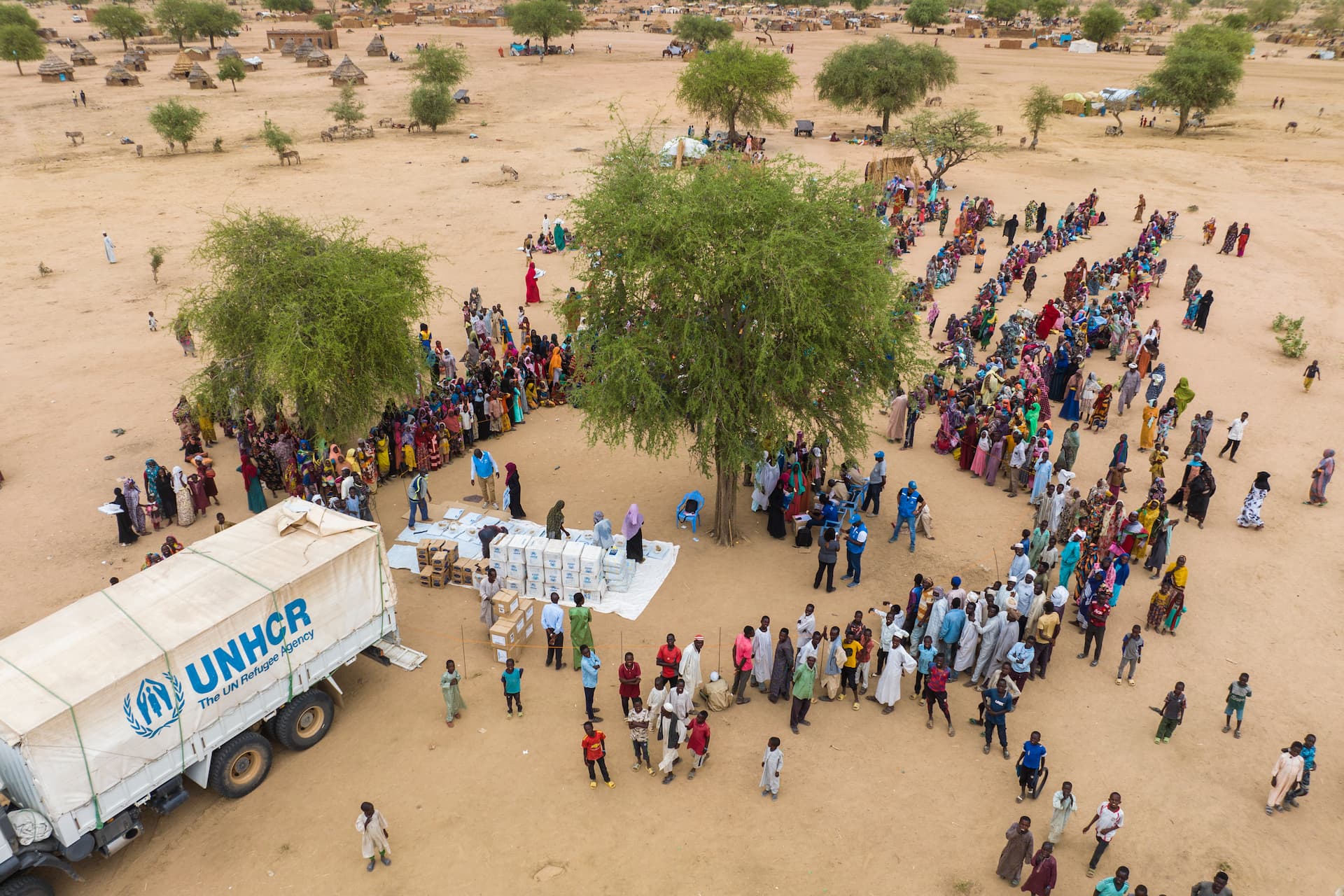
Relief items kits are distributed to newly arrived Sudanese refugees at the Madjigilta site in Chad's Ouaddaï region, on the border with Sudan. © UNHCR/ Colin Delfosse
UNHCR’s Global Data Service (GDS) drives the organization’s global data agenda, enabling evidence-based protection and assistance for forcibly displaced and stateless people. Through leadership in refugee registration, statistics, data access, analysis, visualization, and archival management – and policies and standards on the same – GDS ensures that data is not just collected, but also transformed into actionable insights that support emergency response, strategic planning resource mobilization and reporting, and sustainable responses.
Refugee Registration & Services
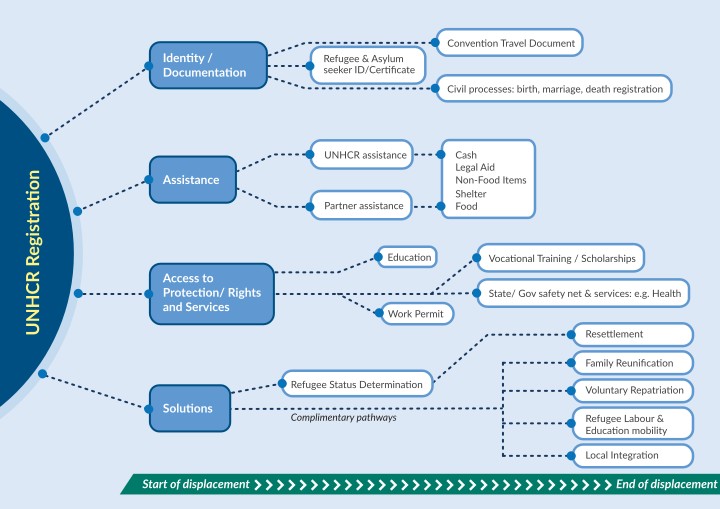
UNHCR and partners register over 100,000 forcibly displaced persons every month across 159 countries and provide them with identity documents, which are essential to provide humanitarian assistance, to access national services like education, health or social protection.
Monthly cumulative registration interactions by country for 2024-2025
Registration is required for resettlement and mandate refugee status determination. UNHCR shares registration data with partners, in line with data protection rules, to enable access to food assistance or resettlement to third countries. GDS sets registration rules and compliance, manages the central identity management and biometrics systems, and provides emergency capacity for rapid response globally.
Registration and protection
Digital Gateway
GDS leads the development and deployment of the Digital Gateway, UNHCR’s global platform providing forcibly displaced and stateless people secure digital access to protection services, self-service tools, and trusted information on their case processing and available services, expanding access and reducing reliance on physical offices. It enables account creation, appointment booking, document management, and multi-channel communication, promoting autonomy, inclusivity, and data privacy while reducing reliance on physical offices and improving operational efficiency.
Digital Gateway
Following successful launches in Egypt, Indonesia, India and Iraq, the Digital Gateway is ready for global roll-out in 2026.
Explore more
“This is very helpful; it will save us time and money.”

Statistics
GDS leads the production of official statistics on displacement, publishing the annual Global Trends report and the Global Compact on Refugees Indicator Report. These globally recognized sources track forced displacement, progress on responsibility-sharing, and inform evidence-based policy, planning, and advocacy, ensuring transparency and accountability in global humanitarian response. UNHCR’s official population statistics are publicly available through its Refugee Data Portal spanning 75 years of data.
The Global Compact on Refugees (GCR) Indicator Report tracks progress towards achieving the four objectives of the GCR.
2025 Global Compact on Refugees Indicator Report
Displacement patterns: Refugees and Internally Displaced People
Each bubble split to show the contrast between internally displaced people and refugees hosted within the country.
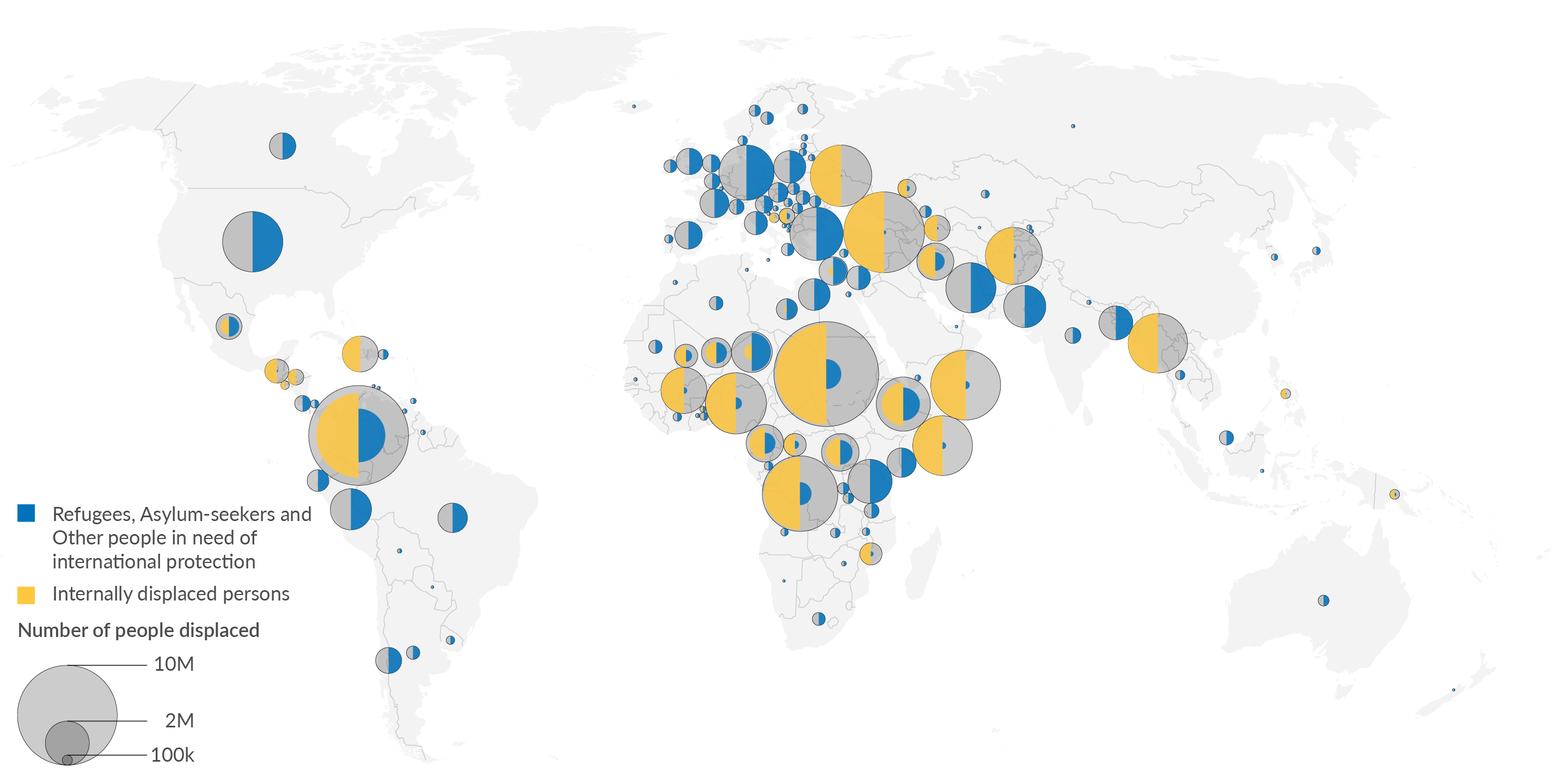
Note: Countries with more than 5,000 displaced in total.
Source: UNHCR Refugee Data Finder
Data Governance
GDS establishes and manages UNHCR’s data governance, ensuring that all data of cross-organizational value is subject to quality standards and high availability through a “single source of truth”. GDS manages UNHCR’s enterprise data platform and data catalogue. These are the foundations for data-driven planning, business intelligence, and decision-making as well as for the public data portal. The public data portal provides responsible open data that supports UNHCR’s donor requirements, its refugee coordination mandate, its commitments in internal displacement situations, and emergency response.

ORION - Country 360 dashboard
Built from the data of 40 internal and external systems, the Country 360 report offers a comprehensive national overview at a glance, including information on population, location, emergencies, indicators, socio-economic data, protection data, budgets and expenditures, appeals, donors, and partners. It automatically synchronizes with source systems so all internal personnel can be confident that they are receiving the latest information.
Explore the dashboardInformation Management
GDS provides operational support through geographic information systems (GIS) for spatial analysis and mapping, Operational Data Portal (ODP) - an information and data sharing platform designed to facilitate coordination during refugee emergencies which recorded over 5 million page views in year 2024, Kobo for mobile data collection with over 48 million recorded submissions, and ActivityInfo for UNHCR and partner reporting and monitoring. Together, these tools enable real-time data capture, visualization, and coordination for key activities such as protection monitoring, multi-sectoral needs assessments and emergency response tracking.


No Escape
Data story
Tens of millions of people uprooted by conflict and violence are increasingly left with nowhere to escape from the devastating effects of the global climate crisis.
Explore the story
Site mapping
Site Mapping provides a comprehensive, geolocated inventory of UNHCR sites, giving decision-makers timely geospatial information to effectively monitor and manage settlements.
Site mapping platform
Protecting the most vulnerable in South Sudan
Data story
Assessing a Complex Crisis through Protection Risks Analysis
Explore the story
Settlement analysis
Mapping and analysis of the population and services in the new formal settlement of Ura in Ethiopia.
Ura camp dashboard
Records and Archives
UNHCR Records and Archives captures, organises, preserves and makes recorded knowledge available when and where it’s needed for those working on behalf of UNHCR’s mandate – whether in refugee protection, accountability, policy making or advocacy. Encompassing records management, digital preservation and research functions, the (award winning) team works in partnership with UNHCR staff globally to secure the long-term integrity and promote the accessibility of information about UNHCR’s operations, as recorded in both analogue and born-digital formats. The Archives comprise over 10 km of physical files and 10+ million digital records, documenting UNHCR’s history from the 1950s to the present day. They are a unique and multi-layered resource for understanding the history of forced displacement and UNHCR’s experience of emergency response, international protection and the promotion of durable solutions. The archives are used actively as a knowledge discovery tool by both internal staff and by a multi-disciplinary academic research community.
The UNHCR Archives
Established in 1996 and opened up to researchers in 2000, UNHCR's archive reveals the human stories of modern forced displacement, offering valuable insights into seismic global events. For the team of UNHCR archivists that oversees the collection, it is a living record of the past and present and a source of inspiration and learning for the future.
The boundaries and names shown and the designations used on this map do not imply official endorsement or acceptance by the United Nations.