Who gets counted
Twenty-five years of data on refugee children
Jul 7, 2026
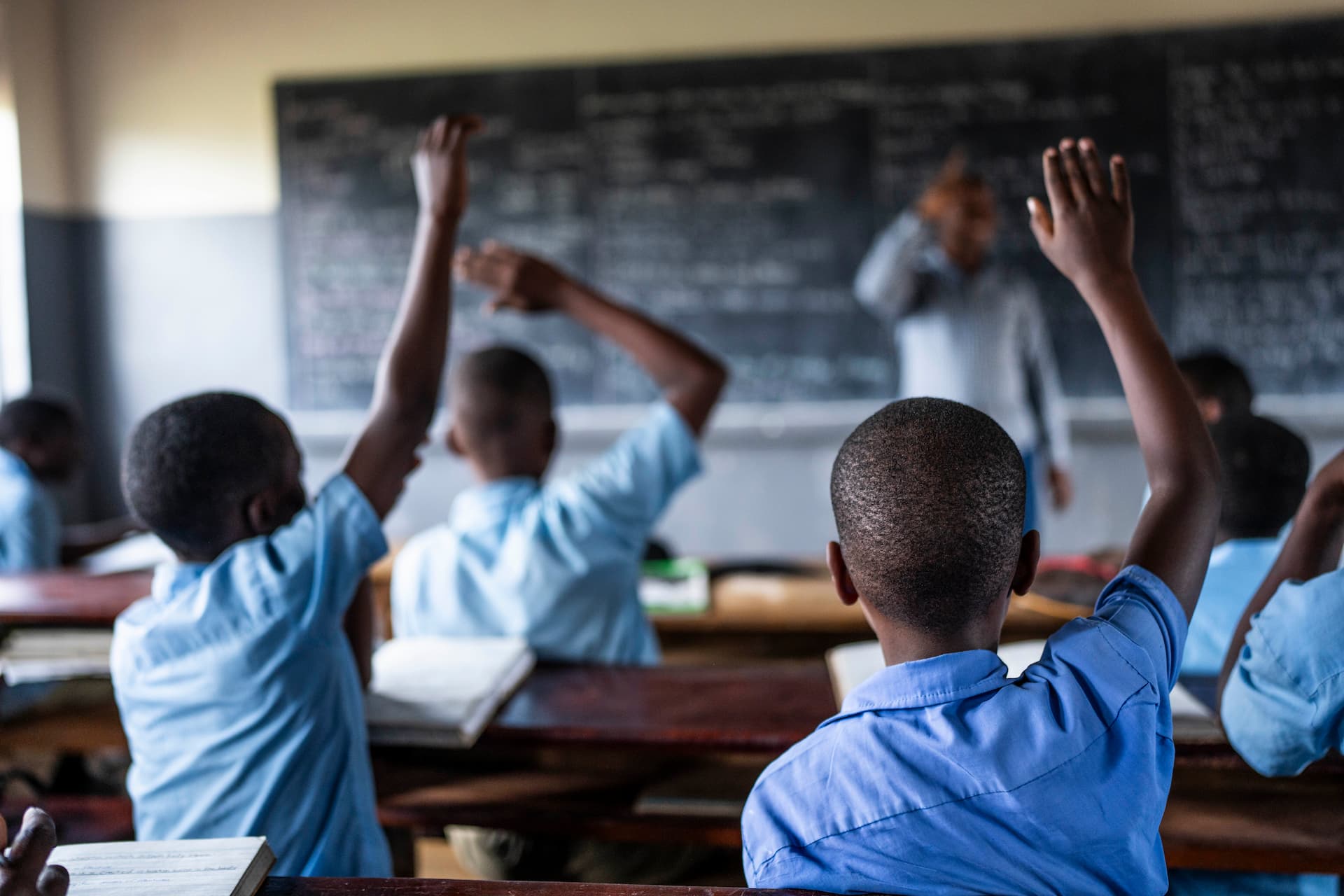
Uganda. Primary school children in class in Nakivale. © UNHCR/Hugh Rutherford
At the end of 2025, 35.6 million people were refugees. Some 39 per cent1 of them were children, compared to roughly 29 per cent of the world’s population. Displacement has always fallen disproportionately on the young, and twenty-five years of demographic data confirms that this is not changing.
This Data Spotlight explores what we know about refugee children, what we are still missing, and what one region’s experience suggests is possible. It draws on the data behind the Global Trends report, UNHCR’s most comprehensive annual overview of forced displacement worldwide.
Note: In this piece, “refugees” refers to refugees, people in a refugee-like situation, and other people in need of international protection unless otherwise stated. See UNHCR’s population categorisations.
A generation of growth
The global refugee population has nearly tripled since 2001, rising from 12.1 million to 35.6 million. The number of children for whom age data is available has grown in this period from just over 3.1 million in 2001 to 11.7 million in 2025.

Yet the full picture remains out of reach. By 2025, no age information was available for roughly one in five refugees, shown here in grey. Without knowing who is a child and who is not, planning for education, protection and other age-specific services relies on estimates rather than evidence.
Dive into refugee data
All data in this piece comes from UNHCR’s Refugee Data Finder, the source behind the Global Trends series of reports.
Zooming in: who are the children?
Among refugees whose age is recorded, children aged 5 to 11 form the largest group (5.2 million in 2025), followed by adolescents aged 12 to 17 (3.9 million) and children under five (2.5 million).
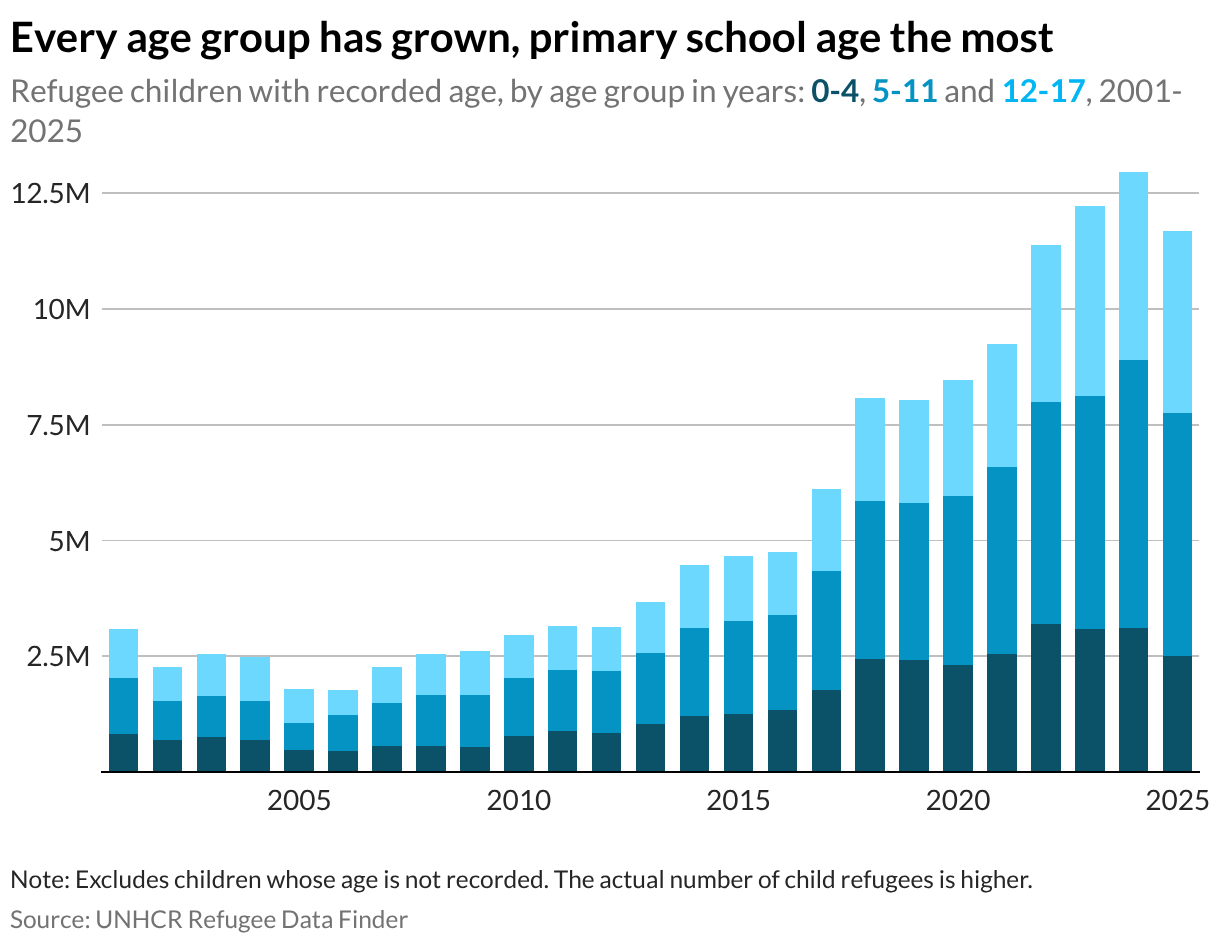
The total number of adolescents grew close to four times in the last twenty-five years. The cohorts passing through secondary school age are larger than ever and many have spent their entire childhood in displacement. Each year, an estimated 305,000 children are born into refugee status (see the UNHCR Global Trends 2025 report, pages 24-5), while older cohorts grow up in displacement.
Always around half
Step back from the absolute numbers and the pattern is remarkably stable. Despite crises erupting in different regions and the total refugee population tripling, the share of children among those whose age is recorded has oscillated only between 40 and 53 per cent during the last 25 years. Children in refugee populations consistently account for a higher proportion than among the world’s population overall. This is not a temporary spike driven by any single emergency. Across crises around the world, women and children are consistently more likely to be forced to flee.

The proportion of refugees that are children (41 per cent at the end of 2025) only includes those people whose age is recorded. At end-2025, demographic data by age and sex was available for 80 per cent of refugees and disaggregation by sex only was available for a further 7 per cent. To fill these data gaps, UNHCR applies statistical modelling to impute the age and sex distribution of populations with missing demographic data. Including these estimates, the proportion of refugees that are children drops to around 39 per cent. The difference represents millions of people whose demographic information is missing.
Where the data is, and where it isn’t
Not all regions face the same data gap. Over twenty-five years, Africa has steadily brought the share of its refugee population with recorded age up to roughly 88 per cent as of the end of 2025. Elsewhere the coverage has also risen, but only reached 77 per cent by the end of 2025.

The two trajectories have not converged in the last two decades. Africa’s investment in systematic individual registration has made age and gender disaggregation the norm rather than the exception. Elsewhere, large-scale protection schemes that register people at aggregate level continue to result in lower levels of demographic disaggregation.
Africa hosts roughly one-quarter of all refugees worldwide. Thanks to the high level of age-disaggregated reporting in Africa, we can say with confidence that almost 45 per cent are children.

The contrast is immediate. In Africa, children account for nearly 45 per cent and the unknown share is nearly half of what it is for all other continents. In the rest of the world, the unknown segment is large enough to shift the entire picture.
Africa’s experience shows that higher rates of age disaggregation in population reporting is achievable at scale, a lesson from Africa to the rest of the world.
Why this matters now
Refugee children are not a temporary feature of displacement. They are its defining demographic. For twenty-five years, children have made up close to half of every refugee population, and that share shows no sign of shifting. The data to understand this exists. In some regions it is comprehensive. In others, millions of children remain invisible. Closing that gap is what will help turn numbers into services, plans, protection and durable solutions. To ensure a child-sensitive and evidence-based approach in its work, UNHCR collaborates with partners through the International Data Alliance for Children on the Move (IDAC) to improve data on forcibly displaced children.
Global Trends 2025 report More on data of children on the move
- The percentage of children is estimated, including imputation techniques used to fill in where data was not available. See working paper on the estimation techniques. ↩︎