Digital Gateway: Connecting People to Services
How the Digital Gateway is expanding access to UNHCR services
Aug 5, 2026
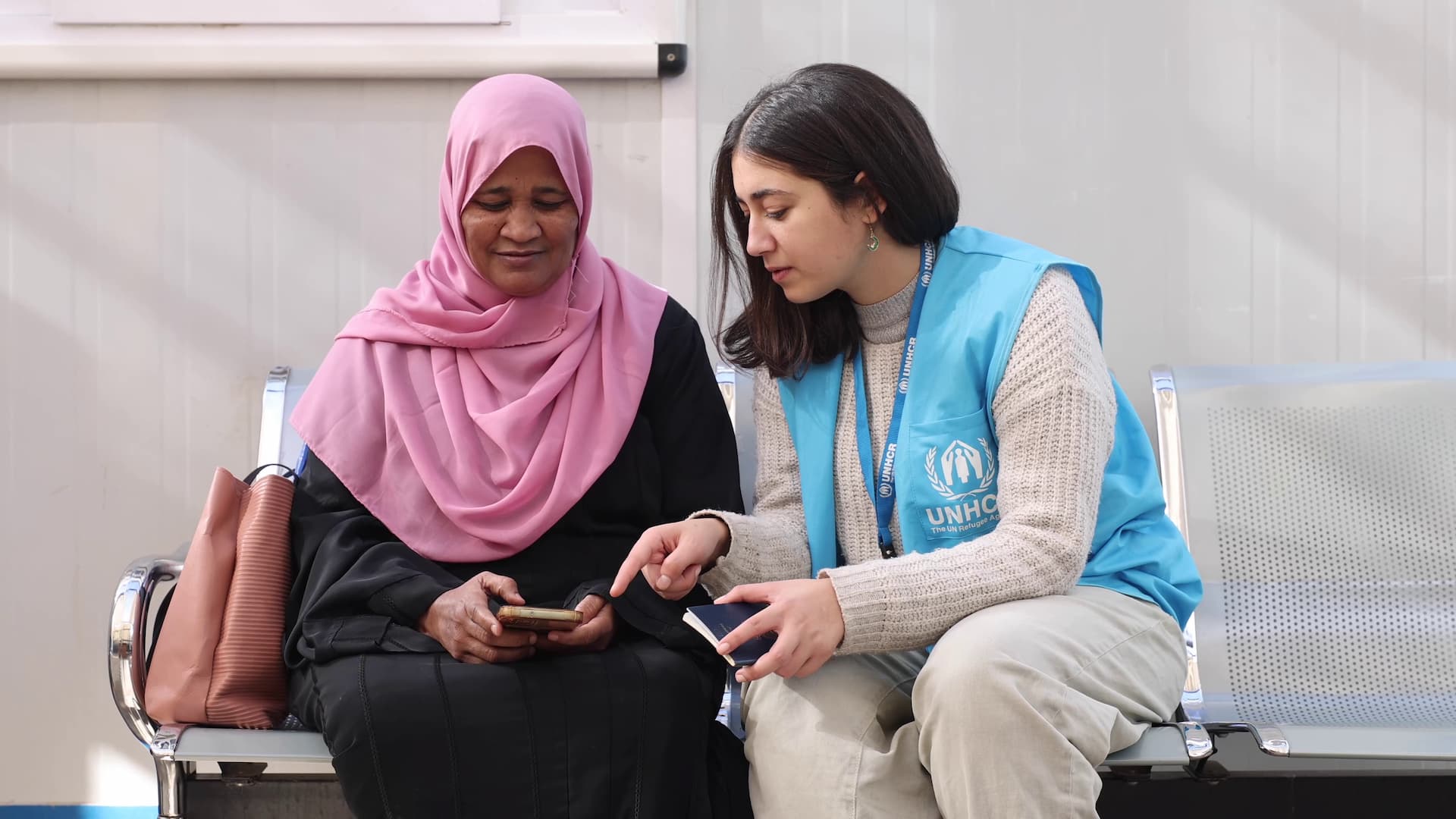
UNHCR staff testing My Services Portal with a Sudanese refugee in Egypt. © UNHCR/Pedro Costa Gomes
Imagine arriving in an unfamiliar country after being forced to flee, only to face long journeys, repeated visits and uncertainty just to find reliable information or begin a registration process. At a time when humanitarian resources are increasingly stretched, making these interactions simpler and more accessible is not only more convenient, it helps ensure that limited in-person support can be focused on those who need it most.
That is the ambition behind the Digital Gateway: to give refugees and asylum-seekers a more direct and secure way to access information, begin important processes and manage selected interactions, with greater choice and control over their own experience.
In a growing number of countries, that vision is becoming a reality. Nearly 300,000 people across seven countries have signed up to My Services, the Digital Gateway’s online self-service portal for refugees and asylum-seekers, which complements other digital and in-person channels.
This Data Spotlight looks at where that pathway starts: what access through the Digital Gateway looks like today.
Seven operations, and counting
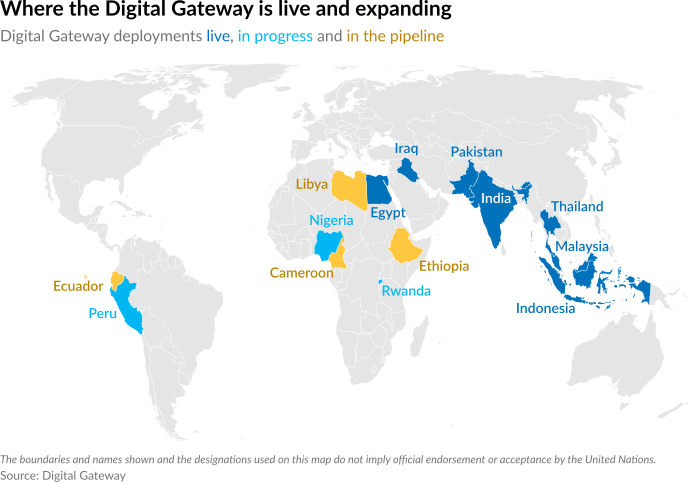
As of July 2026, the Digital Gateway is live in seven UNHCR operations: Egypt, Indonesia, Iraq, India, Thailand, Pakistan and Malaysia. Together, these operations have onboarded nearly 300,000 people onto the My Services portal, from Sudanese, Syrian, Afghan, Myanmar and Somali refugee communities, among many others.
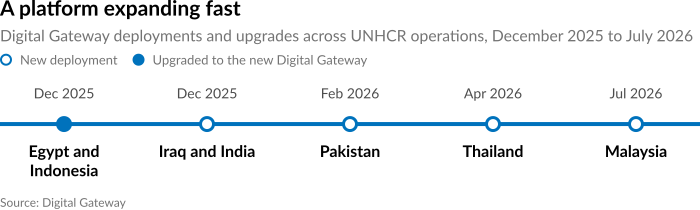
Earlier versions of the platform were introduced in Egypt and Indonesia in 2024, including during the large-scale emergency response for Sudanese refugees in Egypt. The current Digital Gateway was first piloted in Iraq and India in December 2025, when the platforms in Egypt and Indonesia were also upgraded. Pakistan, Thailand and Malaysia followed in the first half of 2026.
Deployments in Peru, Rwanda and Nigeria are planned for the coming months, with several more in the pipeline. Each new deployment brings the platform to a new operational context and expands its linguistic reach. The My Services portal is currently available in eight languages—English, Arabic, Kurdish, Somali, Farsi, Bahasa Indonesia, Pashto and Burmese—with Spanish, French and Kinyarwanda to follow.
The Digital Gateway is no longer just a pilot. Across these seven contexts, and increasingly beyond them, it is becoming an established channel used by hundreds of thousands of people.
Where access begins
Digital access rarely begins with an account. For many refugees and asylum-seekers, the first digital point of contact with UNHCR is a country Help site, a public, country-specific website where people can find information about services and support they may be able to access. Available in more than 30 languages, Help sites reflect the diversity of the communities they serve and receive millions of visits globally each year.
In every operation where My Services is live, the country Help site also provides the entry point to the portal. Since the portal was launched in these operations, related Help site content has collectively received more than four million page views. These pages explain how My Services works and direct people to create an account, sign in and use the portal.

Trusted information, in the right language, at the right moment, is where digital access begins.
How people reach the platform
Once people reach the My Services portal through a country Help site, what happens next depends on whether they are already registered with UNHCR. Across the seven countries where the portal is live, there are two main ways to sign up.
People who are not yet registered with UNHCR can create an account and submit a registration request through My Services. This is especially useful in countries receiving large numbers of new arrivals, where in-person services may be under significant pressure. In Egypt, where the Digital Gateway supports the response to people fleeing the conflict in Sudan, nearly 165,000 people have submitted registration requests online.

People use the portal to request registration for themselves and their accompanying family members. Submitting a request online does not itself complete registration, but it allows people to begin the process and provide initial information digitally.
People who are already registered with UNHCR can be invited to create a My Services account linked to their existing registration record. Once connected, they can view information and access services for themselves and their registered family members. This is the main approach in countries such as Iraq, Pakistan, India and Indonesia, where the Digital Gateway is being introduced to established refugee and asylum-seeker populations. In Iraq, more than 80,000 people have joined My Services this way.

Both pathways have scaled steadily since the platform launched. They respond to different needs: people who are not yet registered can begin the process online, while those already registered can connect to their existing record and access services digitally.
Together, they make the Digital Gateway an additional way for people to access information and services, alongside existing in-person and communication channels.
Looking ahead
The Digital Gateway is now live in seven very different country contexts, adapting to the needs of people arriving during an emergency as well as those who have been registered for many years.
For refugees and asylum-seekers, its value is practical: fewer unnecessary journeys, easier access to trusted information, more flexibility in submitting and managing requests, and greater visibility and control over the information held about them. By enabling routine interactions to take place digitally, the platform can also free up staff time and in-person capacity for people who need direct support most. As the Digital Gateway expands, more people can benefit from services that are easier to reach, while face-to-face assistance remains available where it matters most.